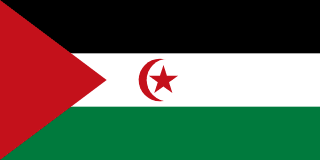
Overview
Western Sahara is a non-self-governing territory on the northwest coast of Africa bordered by Morocco, Mauritania, and Algeria. After Spain withdrew from its former colony of Spanish Sahara in 1976, Morocco annexed the northern two-thirds of Western Sahara and claimed the rest of the territory in 1979, following Mauritania's withdrawal. A guerrilla war with the Polisario Front contesting Morocco's sovereignty ended in a 1991 cease-fire and the establishment of a UN peacekeeping operation. As part of this effort, the UN sought to offer a choice to the peoples of Western Sahara between independence (favored by the Polisario Front) or integration into Morocco. A proposed referendum on the question of independence never took place due to lack of agreement on voter eligibility. The approximately 1,600 km- (almost 1,000 mi-) long defensive sand berm, built by the Moroccans from 1980 to 1987 and running the length of the territory, continues to separate the opposing forces, with Morocco controlling the roughly three-quarters of the territory west of the berm. There are periodic ethnic tensions between the native Sahrawi population and Moroccan immigrants. Morocco maintains a heavy security presence in the territory. The UN revived direct talks about the territory between Morocco, the Polisario Front, Algeria, and Mauritania in December 2018.
Geography
- Location
- Northern Africa, bordering the North Atlantic Ocean, between Mauritania and Morocco
- Total Area
- 266,000 sq km
- Climate
- hot, dry desert; rain is rare; cold offshore air currents produce fog and heavy dew
- Terrain
- mostly low, flat desert with large areas of rocky or sandy surfaces rising to small mountains in south and northeast
- Natural Resources
- phosphates, iron ore
- Coastline
- 1,110 km
- Land Borders
- 2,049 km
People & Society
- Languages
- Standard Arabic, Hassaniya Arabic, Moroccan Arabic, Berber, Spanish, French
- Religions
- Muslim
- Ethnic Groups
- Arab, Berber
- Life Expectancy
- 64.5 years
- Urbanization
- 86.8% of total population (2020)
Government
- Government Type
- legal status of territory and issue of sovereignty unresolved; territory contested by Morocco and Polisario Front (Popular Front for the Liberation of the Saguia el Hamra and Rio de Oro), which in February 1976 formally proclaimed a government-in-exile of the Sahrawi Arab Democratic Republic (SADR), near Tindouf, Algeria, led by President Mohamed ABDELAZIZ until his death in May 2016; current President Brahim GHALI elected in July 2016; territory partitioned between Morocco and Mauritania in April 1976 when Spain withdrew, with Morocco acquiring northern two-thirds; Mauritania, under pressure from Polisario guerrillas, abandoned all claims to its portion in August 1979; Morocco moved to occupy that sector shortly thereafter and has since asserted administrative control; the Polisario's government-in-exile was seated as an Organization of African Unity (OAU) member in 1984; Morocco between 1980 and 1987 built a fortified sand berm delineating the roughly 75% of Western Sahara west of the barrier that currently is controlled by Morocco; guerrilla activities continued sporadically until a UN-monitored cease-fire was implemented on 6 September 1991 (Security Council Resolution 690) by the United Nations Mission for the Referendum in Western Sahara (MINURSO)
Economy
- Economic Overview
- Western Sahara has a small market-based economy whose main industries are fishing, phosphate mining, tourism, and pastoral nomadism. The territory's arid desert climate makes sedentary agriculture difficult, and much of its food is imported. The Moroccan Government administers Western Sahara's economy and is a key source of employment, infrastructure development, and social spending in the territory. ++ Western Sahara's unresolved legal status makes the exploitation of its natural resources a contentious issue between Morocco and the Polisario. Morocco and the EU in December 2013 finalized a four-year agreement allowing European vessels to fish off the coast of Morocco, including disputed waters off the coast of Western Sahara. As of April 2018, Moroccan and EU authorities were negotiating an amendment to renew the agreement. ++ Oil has never been found in Western Sahara in commercially significant quantities, but Morocco and the Polisario have quarreled over rights to authorize and benefit from oil exploration in the territory. Western Sahara's main long-term economic challenge is the development of a more diverse set of industries capable of providing greater employment and income to the territory. However, following King MOHAMMED VI's November 2015 visit to Western Sahara, the Government of Morocco announced a series of investments aimed at spurring economic activity in the region, while the General Confederation of Moroccan Enterprises announced a $609 million investment initiative in the region in March 2015.
- GDP (Official Rate)
- NA
- Major Industries
- phosphate mining, handicrafts