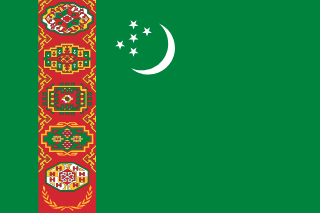
Overview
Present-day Turkmenistan has been at the crossroads of civilizations for centuries. Various Persian empires ruled the area in antiquity, and Alexander the Great, Muslim armies, the Mongols, Turkic warriors, and eventually the Russians conquered it. In medieval times, Merv (located in present-day Mary province) was one of the great cities of the Islamic world and an important stop on the Silk Road. Annexed by Russia in the late 1800s, Turkmen territories later figured prominently in the anti-Bolshevik resistance in Central Asia. In 1924, Turkmenistan became a Soviet republic; it achieved independence when the USSR dissolved in 1991. President for Life Saparmurat NIYAZOV died in 2006, and Gurbanguly BERDIMUHAMEDOV, a deputy chairman under NIYAZOW, emerged as the country's new president. BERDIMUHAMEDOV won Turkmenistan's first multi-candidate presidential election in 2007, and again in 2012 and 2017 with over 97% of the vote in elections widely regarded as undemocratic. In 2022, BERDIMUHAMEDOV announced that he would step down from the presidency and called for an election to replace him. His son, Serdar BERDIMUHAMEDOV, won the ensuing election with 73% of the vote. Gurbanguly BERDIMUHAMEDOV, although no longer head of state, maintains an influential political position as head of the Halk Maslahaty (People’s Council) and as National Leader of the Turkmen People, a title that provides additional privileges and immunity for him and his family. Since Gurbanguly BERDIMUHAMEDOV stepped down from the presidency, state-controlled media upgraded his honorific from Arkadag (protector) to Hero-Arkadag, and began referring to Serdar BERDIMUHAMEDOV as Arkadagly Serdar, which can be translated as "Serdar who has a protector to support him."Turkmenistan has sought new export markets for its extensive hydrocarbon/natural gas reserves, which have yet to be fully exploited. Turkmenistan's reliance on gas exports has made the economy vulnerable to fluctuations in the global energy market, and economic hardships since the drop in energy prices in 2014 have led many citizens of Turkmenistan to emigrate, mostly to Turkey.
Geography
- Location
- Central Asia, bordering the Caspian Sea, between Iran and Kazakhstan
- Total Area
- 488,100 sq km
- Climate
- subtropical desert
- Terrain
- flat-to-rolling sandy desert with dunes rising to mountains in the south; low mountains along border with Iran; borders Caspian Sea in west
- Natural Resources
- petroleum, natural gas, sulfur, salt
- Coastline
- 0 km (landlocked)
- Land Borders
- 4,158 km
People & Society
- Population
- 5,744,151 (2024 est.)
- Religions
- Muslim 93%, Christian 6.4%, Buddhist 1%, folk religion 1%, Jewish 1%, other 1%, unspecified 1% (2020 est.)
- Ethnic Groups
- Turkmen 85%, Uzbek 5%, Russian 4%, other 6% (2003 est.)
- Life Expectancy
- 72.4 years (2024 est.)
- Literacy Rate
- 99.9% (2022 est.)
- Urbanization
- 54% of total population (2023)
Government
- Government Type
- presidential republic; authoritarian
- Capital
- Ashgabat (Ashkhabad)
- Independence
- 27 October 1991 (from the Soviet Union)
- Constitution
- several previous; latest adopted 14 September 2016
- Legal System
- civil law system with Islamic (sharia) law influences
- Executive Branch
- President Serdar BERDIMUHAMEDOV (since 19 March 2022)
Economy
- Economic Overview
- upper-middle-income Central Asian economy; houses fourth-largest natural gas reserves and rich in natural resources; authoritarian and dominated by state-owned enterprises; challenges include overvalued currency, high inflation risks, lack of economic diversification due to heavy state control and bureaucracy
- GDP (Official Rate)
- $64.24 billion (2024 est.)
- Major Industries
- natural gas, oil, petroleum products, textiles, food processing
Infrastructure & Communications
- Railways
- 5,113 km (2017)