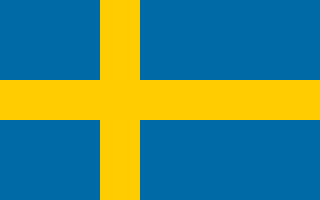
Overview
A military power during the 17th century, Sweden maintained a policy of military non-alignment until it applied to join NATO in 2022. Sweden has not participated in any war for two centuries. Stockholm preserved an armed neutrality in both World Wars. Since then, Sweden has pursued a successful economic formula consisting of a capitalist system intermixed with substantial welfare elements. Sweden joined the EU in 1995, but the public rejected the introduction of the euro in a 2003 referendum. The share of Sweden’s population born abroad increased from 11.3% in 2000 to 20% in 2022.
Geography
- Location
- Northern Europe, bordering the Baltic Sea, Gulf of Bothnia, Kattegat, and Skagerrak, between Finland and Norway
- Total Area
- 450,295 sq km
- Climate
- temperate in south with cold, cloudy winters and cool, partly cloudy summers; subarctic in north
- Terrain
- mostly flat or gently rolling lowlands; mountains in west
- Natural Resources
- iron ore, copper, lead, zinc, gold, silver, tungsten, uranium, arsenic, feldspar, timber, hydropower
- Coastline
- 3,218 km
- Land Borders
- 2,211 km
People & Society
- Population
- 10,643,745 (2025 est.)
- Religions
- Church of Sweden (Lutheran) 53.9%, other (includes Roman Catholic, Orthodox, Baptist, Muslim, Jewish, and Buddhist) 8.9%, none or unspecified 37.2% (2021 est.)
- Ethnic Groups
- Swedish 79.6%, Syrian 1.9%, Iraqi 1.4%, Finnish 1.3%, other 15.8% (2022 est.)
- Life Expectancy
- 82.9 years (2024 est.)
- Urbanization
- 88.7% of total population (2023)
Government
- Government Type
- parliamentary constitutional monarchy
- Capital
- Stockholm
- Independence
- 6 June 1523 (Gustav VASA elected king of Sweden, marking the abolishment of the Kalmar Union of Denmark, Norway, and Sweden)
- Constitution
- Sweden has four fundamental laws which together make up the Constitution: The Instrument of Government (several previous; latest 1974); The Act of Succession (enacted 1810; changed in 1937 and 1980); The Freedom of the Press Act (many previous; latest in 1949); The Fundamental Law on Freedom of Expression (adopted 1991)
- Legal System
- civil law system influenced by Roman-Germanic law and customary law
- Executive Branch
- King CARL XVI GUSTAF (since 15 September 1973)
Economy
- Economic Overview
- high-income, largest Nordic economy; EU member but does not use the euro; export-oriented, led by automotive, electronics, machinery, and pharmaceuticals; highly ranked for competitiveness, R D investments and governance; recovery, with falling inflation and real wage growth balanced by risks from trade uncertainty
- GDP (Official Rate)
- $610.118 billion (2024 est.)
- Major Industries
- iron and steel, precision equipment (bearings, radio and telephone parts, armaments), wood pulp and paper products, processed foods, motor vehicles
Infrastructure & Communications
- Railways
- 10,910 km (2020) 8,184 km electrified