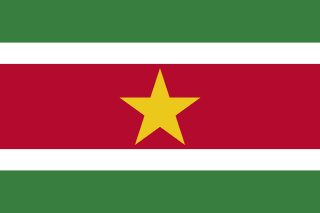
Overview
The Spaniards first explored Suriname in the 16th century, and the English then settled it in the mid-17th century. Suriname became a Dutch colony in 1667. With the abolition of African slavery in 1863, workers were brought in from India and Java. The Netherlands granted the colony independence in 1975. Five years later, the civilian government was replaced by a military regime that soon declared Suriname a socialist republic. It continued to exert control through a succession of nominally civilian administrations until 1987, when international pressure finally forced a democratic election. In 1990, the military overthrew the civilian leadership, but a democratically elected government -- a four-party coalition -- returned to power in 1991. The coalition expanded to eight parties in 2005 and ruled until 2010, when voters returned former military leader Desire BOUTERSE and his opposition coalition to power. President BOUTERSE ran unopposed in 2015 and was reelected. Opposition parties campaigned hard against BOUTERSE in the run-up to the 2020 elections, and a multi-party coalition led by Chandrikapersad SANTOKHI s VHP and Ronnie Brunswijk s ABOP was installed.
Geography
- Location
- Northern South America, bordering the North Atlantic Ocean, between French Guiana and Guyana
- Total Area
- 163,820 sq km
- Climate
- tropical; moderated by trade winds
- Terrain
- mostly rolling hills; narrow coastal plain with swamps
- Natural Resources
- timber, hydropower, fish, kaolin, shrimp, bauxite, gold, and small amounts of nickel, copper, platinum, iron ore
- Coastline
- 386 km
- Land Borders
- 1,907 km
People & Society
- Population
- 653,605 (2025 est.)
- Religions
- Protestant 23.6% (includes Evangelical 11.2%, Moravian 11.2%, Reformed 0.7%, Lutheran 0.5%), Hindu 22.3%, Roman Catholic 21.6%, Muslim 13.8%, other Christian 3.2%, Winti 1.8%, Jehovah's Witness 1.2%, other 1.7%, none 7.5%, unspecified 3.2% (2012 est.)
- Ethnic Groups
- Hindustani (also known locally as "East Indians"; their ancestors emigrated from northern India in the latter part of the 19th century) 27.4%, Maroon (their African ancestors were brought to the country in the 17th and 18th centuries as slaves and escaped to the interior) 21.7%, Creole (mixed White and Black) 15.7%, Javanese 13.7%, mixed 13.4%, other 7.6%, unspecified 0.6% (2012 est.)
- Life Expectancy
- 72.7 years (2024 est.)
- Urbanization
- 66.4% of total population (2023)
Government
- Government Type
- presidential republic
- Capital
- Paramaribo
- Independence
- 25 November 1975 (from the Netherlands)
- Constitution
- previous 1975; latest ratified 30 September 1987, effective 30 October 1987
- Legal System
- civil law system influenced by Dutch civil law
- Executive Branch
- President Jennifer GEERLINGS-SIMONS (since 16 July 2025)
Economy
- Economic Overview
- upper middle-income South American economy; new floating currency regime; key aluminum goods, gold, and hydrocarbon exporter; new IMF plan for economic recovery and fiscal sustainability; controversial hardwood industry
- GDP (Official Rate)
- $4.714 billion (2024 est.)
- Major Industries
- gold mining, oil, lumber, food processing, fishing