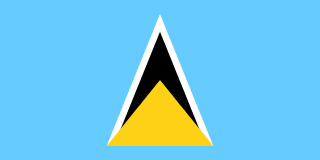
Overview
England and France contested Saint Lucia -- with its fine natural harbor at Castries and burgeoning sugar industry -- throughout the 17th and early 18th centuries, with possession changing 14 times; it was finally ceded to the UK in 1814 and became part of the British Windward Islands colony. Even after the abolition of slavery on its plantations in 1834, Saint Lucia remained an agricultural island, dedicated to producing tropical commodity crops. In the mid-20th century, Saint Lucia joined the West Indies Federation (1958 1962) and in 1967 became one of the six members of the West Indies Associated States, with internal self-government. In 1979, Saint Lucia gained full independence.
Geography
- Location
- Caribbean, island between the Caribbean Sea and North Atlantic Ocean, north of Trinidad and Tobago
- Total Area
- 616 sq km
- Climate
- tropical, moderated by northeast trade winds; dry season January to April, rainy season May to August
- Terrain
- volcanic and mountainous with broad, fertile valleys
- Natural Resources
- forests, sandy beaches, minerals (pumice), mineral springs, geothermal potential
- Coastline
- 158 km
- Land Borders
- 0 km
People & Society
- Population
- 168,462 (2025 est.)
- Languages
- English (official), Saint Lucian Creole
- Religions
- Roman Catholic 61.5%, Protestant 25.5% (includes Seventh Day Adventist 10.4%, Pentecostal 8.9%, Baptist 2.2%, Anglican 1.6%, Church of God 1.5%, other Protestant 0.9%), other Christian 3.4% (includes Evangelical 2.3% and Jehovah's Witness 1.1%), Rastafarian 1.9%, other 0.4%, none 5.9%, unspecified 1.4% (2010 est.)
- Ethnic Groups
- Black/African descent 85.3%, mixed 10.9%, East Indian 2.2%, other 1.6%, unspecified 0.1% (2010 est.)
- Life Expectancy
- 79.4 years (2024 est.)
- Urbanization
- 19.2% of total population (2023)
Government
- Government Type
- parliamentary democracy under a constitutional monarchy; a Commonwealth realm
- Capital
- Castries
- Independence
- 22 February 1979 (from the UK)
- Constitution
- previous 1958, 1960 (pre-independence); latest presented 20 December 1978, effective 22 February 1979
- Legal System
- English common law
- Executive Branch
- King CHARLES III (since 8 September 2022); represented by Acting Governor General Cyril Errol CHARLES (since 11 November 2021)
Economy
- Economic Overview
- upper middle-income, tourism-based Caribbean island economy; environmentally fragile; energy import-dependent; major banana producer; well-educated labor force; key infrastructure, IT, and communications investments
- GDP (Official Rate)
- $2.549 billion (2024 est.)
- Major Industries
- tourism; clothing, assembly of electronic components, beverages, corrugated cardboard boxes, lime processing, coconut processing