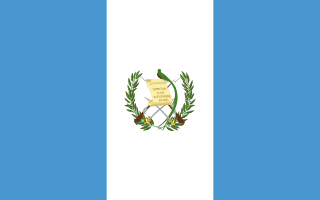
Overview
The Maya civilization flourished in Guatemala and surrounding regions during the first millennium A.D. After almost three centuries as a Spanish colony, Guatemala won its independence in 1821. During the second half of the 20th century, it experienced a variety of military and civilian governments, as well as a 36-year guerrilla war. In 1996, the government signed a peace agreement formally ending the internal conflict.
Geography
- Location
- Central America, bordering the North Pacific Ocean, between El Salvador and Mexico, and bordering the Gulf of Honduras (Caribbean Sea) between Honduras and Belize
- Total Area
- 108,889 sq km
- Climate
- tropical; hot, humid in lowlands; cooler in highlands
- Terrain
- two east-west trending mountain chains divide the country into three regions: the mountainous highlands, the Pacific coast south of mountains, and the vast northern Peten lowlands
- Natural Resources
- petroleum, nickel, rare woods, fish, chicle, hydropower
- Coastline
- 400 km
- Land Borders
- 1,667 km
People & Society
- Population
- 18,255,216 (2024 est.)
- Religions
- Evangelical 45.7%, Roman Catholic 42.4%, none 11%, unspecified 0.9% (2023 est.)
- Ethnic Groups
- Mestizo (mixed Indigenous-Spanish - in local Spanish called Ladino) 56%, Maya 41.7%, Xinca (Indigenous, non-Maya) 1.8%, African descent 0.2%, Garifuna (mixed West and Central African, Island Carib, and Arawak) 0.1%, foreign 0.2% (2018 est.)
- Life Expectancy
- 73.5 years (2024 est.)
- Literacy Rate
- 82.1% (2024 est.)
- Urbanization
- 53.1% of total population (2023)
Government
- Government Type
- presidential republic
- Capital
- Guatemala City
- Independence
- 15 September 1821 (from Spain)
- Constitution
- several previous; latest adopted 31 May 1985, effective 14 January 1986; suspended and reinstated in 1994
- Legal System
- civil law system; judicial review of legislative acts
- Executive Branch
- President Bernardo AR VALO de Le n (since 15 January 2024)
Economy
- Economic Overview
- developing Central American economy; steady economic growth fueled by remittances; high poverty and income inequality; limited government services, lack of employment opportunities, and frequent natural disasters impede human development efforts and drive emigration
- GDP (Official Rate)
- $113.2 billion (2024 est.)
- Major Industries
- sugar, textiles and clothing, furniture, chemicals, petroleum, metals, rubber, tourism
Infrastructure & Communications
- Railways
- 800 km (2018)