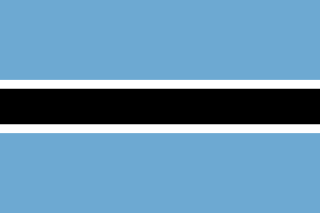
Overview
In the early 1800s, multiple political entities in what is now Botswana were destabilized or destroyed by a series of conflicts and population movements in southern Africa. By the end of this period, the Tswana ethnic group, who also live across the border in South Africa, had become the most prominent group in the area. In 1852, Tswana forces halted the expansion of white Afrikaner settlers who were seeking to expand their territory northwards into what is now Botswana. In 1885, Great Britain claimed territory that roughly corresponds with modern day Botswana as a protectorate called Bechuanaland. Upon independence in 1966, the British protectorate of Bechuanaland adopted the new name of Botswana, which means "land of the Tswana." More than five decades of uninterrupted civilian leadership, progressive social policies, and significant capital investment have created an enduring democracy and upper-middle-income economy. The ruling Botswana Democratic Party has won every national election since independence; President Mokgweetsi Eric Keabetswe MASISI assumed the presidency in 2018 after the retirement of former President Ian KHAMA due to constitutional term limits. MASISI won his first election as president in 2019, and he is Botswana’s fifth president since independence. Mineral extraction, principally diamond mining, dominates economic activity, though tourism is a growing sector due to the country's conservation practices and extensive nature preserves. Botswana has one of the world's highest rates of HIV/AIDS infection but also one of Africa's most progressive and comprehensive programs for dealing with the disease.
Geography
- Location
- Southern Africa, north of South Africa
- Total Area
- 581,730 sq km
- Climate
- semiarid; warm winters and hot summers
- Terrain
- predominantly flat to gently rolling tableland; Kalahari Desert in southwest
- Natural Resources
- diamonds, copper, nickel, salt, soda ash, potash, coal, iron ore, silver
- Coastline
- 0 km (landlocked)
- Land Borders
- 4,347.15 km
People & Society
- Population
- 2,521,534 (2025 est.)
- Languages
- Setswana 77.3%, Sekalanga 7.4%, Shekgalagadi 3.4%, English (official) 2.8%, Zezuru/Shona 2%, Sesarwa 1.7%, Sembukushu 1.6%, Ndebele 1%, other 2.8% (2011 est.)
- Religions
- Christian 79.1%, Badimo 4.1%, other 1.4% (includes Baha'i, Hindu, Muslim, Rastafarian), none 15.2%, unspecified 0.3% (2011 est.)
- Ethnic Groups
- Tswana (or Setswana) 79%, Kalanga 11%, Basarwa 3%, other, including Kgalagadi and people of European ancestry 7%
- Life Expectancy
- 66.4 years (2024 est.)
- Urbanization
- 72.9% of total population (2023)
Government
- Government Type
- parliamentary republic
- Capital
- Gaborone
- Independence
- 30 September 1966 (from the UK)
- Constitution
- previous 1960 (pre-independence); latest adopted March 1965, effective 30 September 1966
- Legal System
- mixed legal system of civil law influenced by the Roman-Dutch model, including customary and common law
- Executive Branch
- President Duma BOKO (since 1 November 2024)
Economy
- Economic Overview
- good economic governance and financial management; diamond-driven growth model declining; rapid poverty reductions; high unemployment, particularly among youth; COVID-19 sharply contracted the economy and recovery is slow; public sector wages have posed fiscal challenges
- GDP (Official Rate)
- $19.401 billion (2024 est.)
- Major Industries
- diamonds, copper, nickel, salt, soda ash, potash, coal, iron ore, silver; beef processing; textiles
Infrastructure & Communications
- Railways
- 888 km (2014)