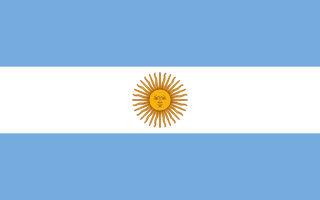
Overview
In 1816, the United Provinces of the Río de la Plata declared their independence from Spain. After Bolivia, Paraguay, and Uruguay went their separate ways, the area that remained became Argentina. European immigrants heavily shaped the country's population and culture, with Italy and Spain providing the largest percentage of newcomers from 1860 to 1930. Until about the mid-20th century, much of Argentina's history was dominated by periods of internal political unrest and conflict between civilian and military factions. After World War II, former President Juan Domingo PERÓN -- the founder of the Peronist political movement -- introduced an era of populism, serving three non-consecutive terms in office until his death in 1974. Direct and indirect military interference in government throughout the PERÓN years led to a military junta taking power in 1976. In 1982, the junta failed in its bid to seize the Falkland Islands (Islas Malvinas) by force from the United Kingdom. Democracy was reinstated in 1983 and has persisted despite numerous challenges, the most formidable of which was a severe economic crisis in 2001-02 that led to violent public protests and the successive resignations of several presidents. The years 2003-15 saw Peronist rule by Néstor KIRCHNER (2003-07) and his spouse Cristina FERNÁNDEZ DE KIRCHNER (2007-15), who oversaw several years of strong economic growth (2003-11) followed by a gradual deterioration in the government’s fiscal situation and eventual economic stagnation and isolation. Argentina underwent a brief period of economic reform and international reintegration under Mauricio MACRI (2015-19), but a recession in 2018-19 and frustration with MACRI’s economic policies ushered in a new Peronist government in 2019 led by President Alberto FERNÁNDEZ and Vice President Cristina FERNÁNDEZ DE KIRCHNER. Argentina's high public debts, its pandemic-related inflationary pressures, and systemic monetary woes served as the catalyst for the 2023 elections, culminating with President Javier MILEI's electoral success. Argentina has since eliminated half of its government agencies and is seeking shock therapy to amend taxation and monetary policies.
Geography
- Location
- Southern South America, bordering the South Atlantic Ocean, between Chile and Uruguay
- Total Area
- 2,780,400 sq km
- Climate
- mostly temperate; arid in southeast; subantarctic in southwest
- Terrain
- rich plains of the Pampas in northern half, flat to rolling plateau of Patagonia in south, rugged Andes along western border
- Natural Resources
- fertile plains of the pampas, lead, zinc, tin, copper, iron ore, manganese, petroleum, uranium, arable land
- Coastline
- 4,989 km
- Land Borders
- 11,968 km
People & Society
- Population
- 45,418,098 (2025 est.)
- Religions
- Roman Catholic 62.9%, Evangelical 15.3% (Pentecostal 13%, other Evangelical 2.3%), Jehovah's Witness and Church of Jesus Christ 1.4%, other 1.2% (includes Muslim, Jewish), none 18.9% (includes agnostic and atheist), unspecified 0.3% (2019 est.)
- Ethnic Groups
- European (mostly Spanish and Italian descent) and Mestizo (mixed European and Indigenous ancestry) 97.2%, Indigenous 2.4%, African descent 0.4% (2010 est.)
- Life Expectancy
- 78.8 years (2024 est.)
- Literacy Rate
- 99.1% (2020 est.)
- Urbanization
- 92.5% of total population (2023)
Government
- Government Type
- presidential republic
- Capital
- Buenos Aires
- Independence
- 9 July 1816 (from Spain)
- Constitution
- several previous; latest effective 11 May 1853
- Legal System
- civil law system based on Western European legal systems
- Executive Branch
- President Javier Gerardo MILEI (since 10 December 2023)
Economy
- Economic Overview
- large diversified economy; financial risks from debt obligations, rapid inflation, and reduced investor appetites; resource-rich, export-led growth model; increasing trade relations with China; G20 and OAS leader; tendency to nationalize businesses and under-report inflation
- GDP (Official Rate)
- $633.267 billion (2024 est.)
- Major Industries
- food processing, motor vehicles, consumer durables, textiles, chemicals and petrochemicals, printing, metallurgy, steel
Infrastructure & Communications
- Railways
- 17,866 km (2018)